The impact of COVID-19 on the African-American Community

Creative Experience
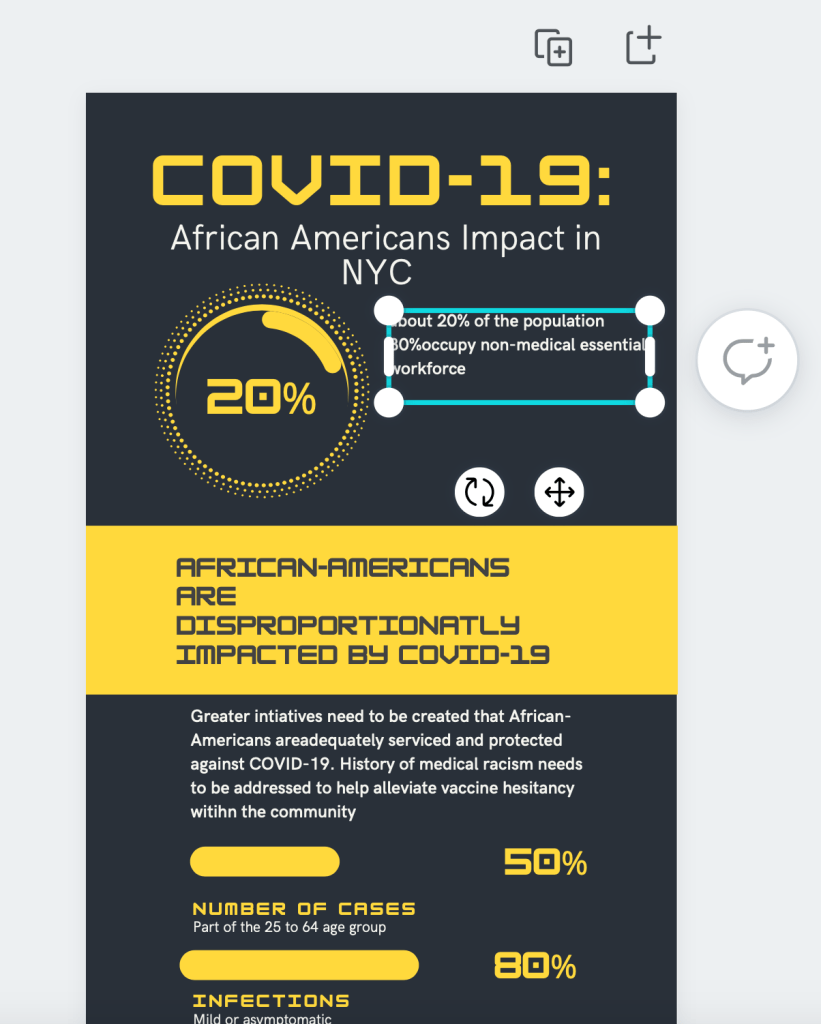
I chose to focus on the impact of COVID-19 on the African American community. African Americans have been disproportionately impacted by the virus, however access to proper medical care is still yet to be established for African-Americans (DiMaggio, Klein, Berry, & Frangos, 2020). Very few initiatives (i.e. call to vaccination) addresses medical racism that has lead to many African-Americans being hesitant about taking the COVID-19 vaccine. I chose the color pattern of yellow and black because those are typically associated with warning signs. So visually this represents a warning that things are amiss within the African-American community. The graphical representation of key data points helps highlight how this population is impacted for those people who are motivated by numbers.
Behind the Scenes of Design
Visual Design Proposal
Title: Learn about the Impact of COVID-19 on the African American community
Concept Overview: This is an infographic that presents the context and data about the impact of COVID-19 on African Americans. The color schemes used is intended to cause alarm, as this is an alarming reality.
Statement of Need: Black people/African Americans account for about 20% of NYC’s population (U.S. Census Bureau, 2020). Additionally, African Americans occupy the largest non-medical essential staff workforce (about 80%) which would require them to continue commuting to work while most of the city worked remotely (DiMaggio et al., 2020). This led to African Americans being disproportionately impacted by COVID-19 as they would be exposed more frequently to the virus via commuting and with anyone they come in contact with while at work.
Concept Description: I created an infographic which has a warning color scheme of yellow and black as way of triggering people that African Americans are dealing with an alarming situation. Data points about the impact are presented with additional context around medical racism, vaccine hesitancy, and disproportionate access to quality care to further emphasize the importance of the messages being made.
Target audience: The audience is health care providers, decision makers, and anyone willing to learn about these public health concerns.
Learning Goals:
- Readers will learn about the population of African Americans in NYC and how much of the population is potentially exposed to the virus.
- Readers will learn about some of the context for the unequal impact of COVID-19 on the African-American community
- Readers will learn about how many people has been infected by COVID-19
Learning Theories:
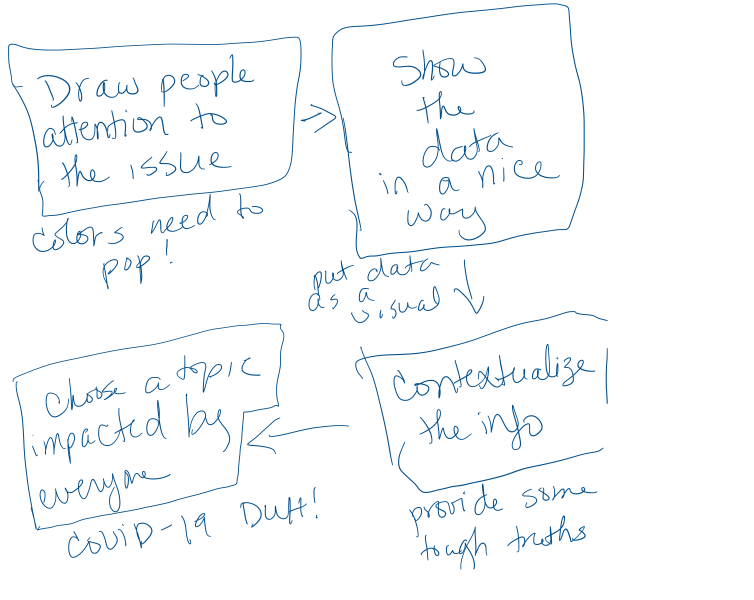
- Cognitive Load Theory (Sweller, 1988): Information is presented that highlights the main points and the color scheme helps alert people of the urgency of this message. This helps with cognitive load as people will not become overwhelmed and will aware of the key message.
References
DiMaggio, C., Klein, M., Berry, C., & Frangos, S. (2020). Black/African American Communities are at highest risk of COVID-19: spatial modeling of New York City ZIP Code–level testing results. Annals of Epidemiology, 51, 7-13. Retrieved from https://www.ncbi.nlm.nih.gov/pmc/articles/PMC7438213/
U.S. Census Bureau. (2020). QuickFacts New York city, New York. Retrieved from https://www.census.gov/quickfacts/newyorkcitynewyork
Sweller, J. (1988). Cognitive load during problem solving: Effects on learning. Cognitive Science, 12, 257–285.
 Woven Stories