Healthcare Disparities
Creative Process
This is a video I created a few years agowhen I was applying to attend the American Public Health Association Annual Conference. The program I used was Animator and shared the video on Youtube. In Animator, I needed to select my characters – I could customize my characters in terms of attire and type of movement that they are making. Then I place the characters in the background that I also chose.Once they are on the template then I was able to set up additional animation to determine when and where they moved using the timeline function at the bottom of the editing screen. Additionally I set the speed in which they are moving across the screen via the timeline functionality. To customize the background of the video I could add objects such as furniture, animals, comment bubbles in which I can customize with messages. I could add effects on the screen such as the splintering of the screen in an effects panel on the right side of the screen. For the voice over I recorded it in Animator. The platform has the option for me to record while the video is playing. The only struggle I had with this is that I am naturally a fast speaker so it was difficult for me to slow down my speech to match the timing of the video. Additionally, in this video I still struggled with the timing of when objects and characters appeared off and on screen and some timing lags between scene transitions. Overall I was pleased with my video as it was the first animation video I created.
Behind the Scenes of Animation!
Since I deactivated my Animator account after I exported my video, this video is no longer available for me to edit. However I recreated my account and below share a screen shot of how the editing platform appears on Animator.

Social Media and Narrative Media
Title: Learning about Health Disparities
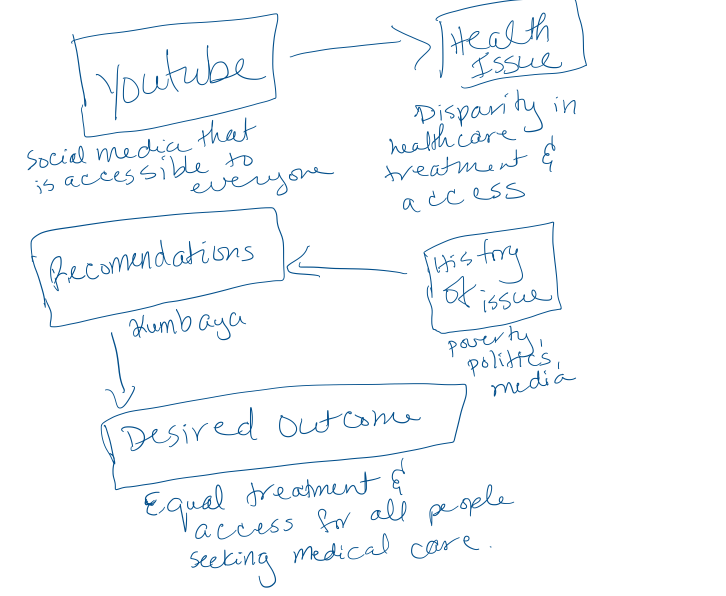
Concept Overview: This video’s primary objective was to explain a public health problem so I could be chosen to attend the American Public Health Association Annual Conference. I created a video that described the issues of health disparities in this country and some of the key reasons why this disparity exists and a recommendation for starting to resolve these issues.
Statement of Need: The murder of George Floyd last year awakened many people to the racism many black people face on a daily basis. This racism extends itself to the medical field which is very problematic for a myriad of reasons. While we have people’s attention on the reality of racism and discrimination, this video serves to add further to the conversation around the maltreatment of people of color within the medical field and hopefully encourages people to advocate for equal medical treatment for varying groups of people. Additionally, uploading this video on the social media platform, YouTube makes it accessible to everyone who has access to internet.
Concept Description: The video starts off with 2 couples in the doctor’s office. The doctor is very welcoming to the white couple, but he is refusing to provide service to the black couple, so the audience sees that they have to leave the office. I narrate the main topic of the video. The next scene is in a poorer neighborhood which is poorly lit, and the characters look sad. It demonstrates the doom of poverty. My narration describes the relationship between poverty and health care. I then touch on the disunity within the political system, the screen is cracked to symbolize how broken the system is when it comes to ideas such as universal healthcare. Lastly, I addressed the media’s influence on shaping people’s perspective. This scene features a family listening to the television in their home. Then I provide recommendations which features a group of people of diverse backgrounds at an event in the park. In the last section of the narrative, we are back to the doctor’s office scene and we see that the couple that was originally turned away are now welcomed at the office.
Target audience: The audience was for the reviewers of the Bill and Melinda Gates Scholarship Program as they were the ones determining if I was eligible to attend the conference based on my video. Additionally, the audience could be anyone interested in learning more about health disparities.
Learning Goals:
- Viewers will be able to learn what health disparities are
- Viewers will learn foundational concepts that create and maintain health disparities
- Viewers will learn best practices to address health disparities
Learning Theories:
- Temporal Continuity Principle (Brannen, 2018): This principle states that people learn best when corresponding words and imagery are presented together. In this video we see that what’s happening on screen is also narrated so that the points are doubly reinforced to help people learn the concepts.
References
Brannen, Katy. “Spatial and Temporal Contiguity Principle Dr Richard Mayer.” Spatial and Temporal Contiguity Principle Dr Richard Mayer, 27 Mar. 2018, http://www.youtube.com/watch?v=34QW0lNL86s.
 Woven Stories